
Author: Mr.Jean Claude Nduwayezu
Research Publication:
“Hidden Yet Recognized: Alchemical Branding, FIFA’s Clean Stadium Policy, and Levi’s Social Media Strategy in the 2026 World Cup”
Abstract
Global sporting mega-events increasingly rely on strict commercial regulation to protect official sponsors, yet host venues often retain deep-rooted brand identities tied to non-sponsoring companies. This tension became especially visible during the 2026 FIFA World Cup, when Levi’s Stadium in Santa Clara, California, was required to comply with FIFA’s clean stadium policy, which mandates the removal or concealment of non-sponsor branding at host venues. While prior research has examined ambush marketing and sponsorship protection in sport, limited attention has been paid to how a brand can achieve visibility precisely through enforced concealment. This study investigates how Levi’s transformed a regulatory constraint into a branding opportunity, examining the strategic and communicative techniques used to maintain brand recognition despite formal erasure, with a focus on the covered stadium signage and the brand’s subsequent social media response. The study adopts a qualitative approach, using a case study design centered on Levi’s Stadium during the 2026 World Cup. Data were drawn from news coverage, publicly available social media posts, and visual documentation of the covered signage, analyzed through thematic and visual content analysis to identify recurring branding strategies and audience reception patterns. Findings reveal that Levi’s used a technique of partial concealment shaping the covering to preserve the recognizable outline of its logo paired with timely, self-aware social media messaging, generating substantial public attention and reinforcing brand recall despite the absence of the company name. The study concludes that strategic partial visibility, or “alchemical branding,” can convert regulatory restriction into a marketing asset, offering a novel lens for understanding brand resilience under sponsorship-exclusion rules. Implications for marketing practice, event sponsorship policy, and future research on regulatory-constrained branding are discussed, alongside limitations related to the single-case design.
Keywords: Alchemical branding, Ambush marketing, clean stadium policy, Levi’s Social Media Strategy, 2026 FIFA World Cup
Introduction
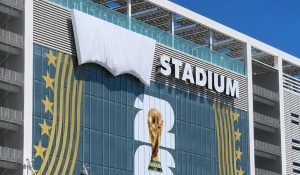
The 2026 FIFA World Cup, co-hosted by the US, Canada, and Mexico, features 48 teams across 16 venues, including Levi’s Stadium in Santa Clara, home of the San Francisco 49ers. Because FIFA enforces a “clean stadium” rule requiring venues to remove non-sponsor branding during the tournament, Levi’s Stadium was temporarily renamed “San Francisco Bay Area Stadium,” with its Levi’s signage covered (though the covering was famously cut to preserve the logo’s outline).
This shows that leisure venues like stadiums, arenas, resorts often carry a company’s name as everyday branding, but that identity isn’t absolute. When an event organiser or regulator sets its own rules, those can temporarily override the venue’s usual commercial branding. Drawing on Lorry Sutherland’s notion of ‘alchemy,’ whereby seemingly irrational ideas can produce disproportionate marketing value, this paper examines how Levi’s transformed logo coverage into a distinctive branding opportunity.”
This paradox echoes the central thesis of Rory Sutherland’s Alchemy, which argues that counter-intuitive, psychologically-driven strategies can outperform conventional rational logic in shaping perception and behavior. Sutherland contends that what appears irrational or constrained on the surface can, under the right conditions, generate outsized attention and value precisely because it defies expected patterns. The Levi’s case exemplifies this alchemy: a restriction designed to erase the brand (its logo physically covered) appears instead to have heightened brand salience, as the visible outline of the covering, amplified through social media attention, generated more public engagement than the original signage likely would have on its own. This suggests that constraint, rather than undermining visibility, can function as an unconventional lever for brand recognition.
“The study’s purpose is to analyse Levi’s use of a covered logo during the 2026 World Cup as a form of alchemical branding and to derive strategic insights for leisure, tourism, and hotel marketers.” It was guided by three research questions:
- How did Levi’s reframe FIFA’s logo restriction into a brand narrative?
- What signals and psychological cues made the covered logo effective?
- What implications does this hold for marketing strategy in leisure, tourism and hospitality contexts?
Literature review
The academic literature on sport sponsorship has long centered on protecting official partners from unauthorized association, a practice known as ambush marketing commonly defined as a strategy by which a non-sponsoring brand creates a deliberate or incidental association with an event to gain promotional benefits without paying for official sponsorship rights. In response, regulatory bodies such as FIFA have progressively tightened enforcement through what is termed the clean stadium (or “clean venue”) policy, a contractual and regulatory measure requiring host venues to remove, cover, or otherwise conceal any commercial branding not affiliated with official tournament sponsors, for the duration of the event. News coverage of the 2026 World Cup confirms this definition in practice: FIFA’s clean stadium regulations have forced host venues across North America to remove sponsor branding during the 2026 World Cup, with FIFA’s clean venue policy extending far beyond stadium façades an enforcement so thorough that even condiment bottles in media areas reportedly had their branding taped over to comply with tournament regulations.
Where the literature offers less consensus is on what happens when a brand is forced into concealment rather than seeking visibility on its own initiative. Some coverage frames this purely as compliance and loss: at Gillette Stadium near Boston, home of the Patriots, large scaffolding structures were erected to cover the venue’s prominent branding, and in Houston, organizers reportedly budgeted more than $1 million to remove signage and conceal logos throughout the venue, temporarily renamed “Houston Stadium” consistent with classical brand visibility theory, which holds that consumer recognition and recall depend on repeated, consistent exposure to a brand’s visual elements, implying that concealment should weaken recognition. Other reporting complicates this view: according to NBC Bay Area coverage, Levi’s embraced FIFA’s branding requirements as a marketing opportunity rather than viewing them as constraints, positioning the same regulatory act as a potential asset rather than a pure loss.
Rory Sutherland’s Alchemy offers a theoretical lens for reconciling this contradiction. Central to the book is the concept of “psycho-logic”, which Sutherland uses to describe how human behavior follows its own evolved rules that diverge sharply from the narrow rationality assumed by economists and technocrats. Where classical brand visibility theory would predict that a hidden logo reduces recognition, psycho-logic suggests that unexpected or counter-intuitive moves can generate disproportionate attention precisely because they break from predictable convention — a theme reviewers note runs through the book’s argument that human behavior does not run on logic, and that this fact often goes unreflected in the data.
Applied to the Levi’s case, this reframes the covered signage not as a failure of branding but as an act of psycho-logic: rather than fully concealing the logo, the white tarp was cut to match the exact outline of the company’s unmistakable batwing emblem, preserving recognizability while technically complying with the rule. This aligns with reception evidence showing that photos of the covered sign quickly spread across social media, after which Levi’s shared an image of the stadium with a caption joking about the tournament’s regulations. Read through Sutherland’s lens, this outcome supports the alchemical position over the purely compliance-based one: the constraint did not simply suppress the brand but, mediated through social amplification, arguably enhanced its salience an outcome brand visibility theory alone would not predict, but psycho-logic anticipates.
Theoretical Review
- Ambush Marketing Theory
Defined by Meenaghan as “the practice whereby another company, often a competitor, intrudes upon public attention surrounding the event, thereby deflecting attention toward themselves and away from the sponsor.” This theory explains how non-sponsoring brands gain visibility during sponsored events without paying official rights fees. Meenaghan, T. (1994). Point of view: Ambush marketing; immoral or imaginative practice? Journal of Advertising Research, 34(5), 77–88. - Sponsorship Exclusivity / Clean Venue Theory
Grounded in sponsorship governance research, this holds that event owners protect official sponsors’ investments by enforcing category exclusivity and controlling all visible branding at the venue, minimizing competing or unauthorized commercial messages. Meenaghan, T. (1991). The role of sponsorship in the marketing communications mix. International Journal of Advertising, 10, 35–48.
- Psycho-Logic (Alchemical Branding Theory)
Rory Sutherland’s concept describing how human behavior follows its own evolved rules, which diverge sharply from the narrow rationality assumed by economists and technocrats. It proposes that counter-intuitive, perception-based strategies can outperform purely rational approaches.
Sutherland, R. (2019). Alchemy: The Dark Art and Curious Science of Creating Magic in Brands, Business, and Life. WH Allen.
- Brand Visibility / Exposure Theory
A classical marketing principle holding that consumer recognition and recall depend on repeated, consistent exposure to a brand’s visual identity implying that concealment or removal of branding should reduce recognition according to the foundational brand-awareness literature in consumer marketing (e.g., Keller’s brand equity framework).
- Consumer-Based Brand Salience
Describes the likelihood a brand comes to mind in relevant purchase or usage situations; traditionally built through consistent exposure, but can also be triggered by novelty, disruption, or unusual events relevant to explaining sudden attention spikes like the Levi’s case. (e.g., Meenaghan, 1998, Ambush marketing: Corporate strategy and consumer reaction. Psychology & Marketing, 15(4), 305–322).
Research review summary
This literature review shows that while FIFA’s clean stadium policy enforces strict removal of non-sponsor branding to protect official partners; consistent with ambush marketing and brand visibility theories, which assume concealment weakens recognition; the Levi’s Stadium case complicates this assumption. Rather than treating the mandated covering of its logo as pure loss, Levi’s preserved the recognizable outline of its emblem and used social media to amplify the moment, generating attention that arguably enhanced brand salience despite formal erasure. Read through Rory Sutherland’s concept of psycho-logic, this outcome suggests that counter-intuitive, perception-driven strategies can outperform conventional branding logic, positioning constraint itself as a potential branding opportunity rather than a straightforward setback.
Research Methodology
This study adopts a qualitative, interpretive case study design, focusing on a single illustrative event Levi’s Stadium’s response to FIFA’s clean stadium policy during the 2026 World Cup. A case study approach was chosen because the research question concerns how and why a specific branding strategy unfolded, rather than measuring its prevalence or statistical significance across a large sample.
Data were drawn from three sources: (1) publicly available news articles and reports documenting the covered stadium signage and FIFA’s enforcement of the clean stadium rule; (2) descriptions of Levi’s public social media response to the covering; and (3) theoretical material from Rory Sutherland’s Alchemy and related branding and consumer psychology literature, used to interpret the case rather than to generate independent data.
Analysis was conducted using thematic, interpretive analysis, in which recurring patterns across the data were identified and grouped into themes reframing constraint, symbolic recognition, earned media, and fan co-creation rather than being tested through statistical or quantitative methods. These themes were then examined against Sutherland’s concept of psycho-logic and mapped onto broader marketing theory relevant to leisure, tourism, and hospitality contexts.
It is important to note that this methodology yields a conceptual, not empirical-statistical, contribution: the study does not measure brand recall, consumer attitudes, or engagement metrics numerically, but instead offers an interpretive analysis of a single real-world event to illustrate and extend existing theory. This approach is well suited to exploratory, theory-building research where the goal is to generate new conceptual understanding rather than to confirm a hypothesis through measurable data.
Conceptual framework
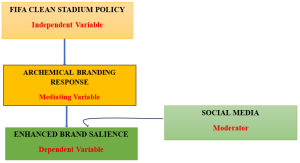
The framework treats FIFA’s clean stadium policy as the independent variable, driving the alchemical branding response (partial visibility, humor) as the mediating mechanism that produces enhanced brand salience as the dependent variable; with social media reach acting as a moderator that strengthens or weakens how far that mediated effect travels.
Analytical approach
This study applies a thematic, interpretive form of analysis to the Levi’s Stadium case, rather than a statistical or quantitative method. Drawing on the news coverage, social media material, and theoretical concepts described above, the analysis identifies recurring themes across the data: reframing constraints, where a regulatory restriction is treated as a creative opportunity rather than a limitation; symbolic recognition, where partial or altered branding still successfully signals brand identity to an audience; earned media, where public and press attention is generated organically through the brand’s response rather than through paid advertising; and fan co-creation, where audiences actively participate in spreading and interpreting the brand moment through their own social media sharing and commentary. These themes are then mapped onto the broader marketing landscape of leisure and tourism venues, where stadiums, arenas, and resorts routinely operate under externally imposed branding restrictions from event organisers, regulators, or licensing bodies. By interpreting the Levi’s case through this thematic lens, the study offers a transferable framework for understanding how leisure and tourism operators might similarly convert regulatory or contractual branding constraints into opportunities for visibility, engagement, and symbolic brand presence.
Findings
- Reframing constraint as creative brief
First, Levi’s reframed FIFA’s restriction from a loss of visibility into a creative brief, using the covered batwing shape as a playful prompt for audience recognition. Rather than treating the mandated concealment as a marketing setback, Levi’s approached it as raw material for storytelling effectively communicating to its audience, “even covered, you know who we are.” This reframing was reinforced through the brand’s own public messaging, which leaned into the situation with self-aware humour rather than silence or resistance. The playful tone transformed what could have been read as corporate erasure into a moment of brand personality, positioning Levi’s not as a passive subject of regulation but as an active participant in the joke.
- The power of partial cues and brand shapes
Second, the case demonstrates the communicative power of partial visual cues. By preserving the exact outline of the batwing emblem rather than concealing it entirely, Levi’s relied on consumers’ ability to recognize the brand from shape alone, without the company name being visible. This finding embodies a central tenet of Sutherland’s Alchemy: that meaning and recognition are often carried through signals and symbolism rather than explicit, literal information. The silhouette functioned as an iconic cue; a minimal, almost abstracted signal that nonetheless retained full brand identification, illustrating how strong brand equity can be sustained even under conditions of enforced restraint.
- Turning physical coverage into digital amplification
Third, the physical concealment of the logo catalyzed online amplification, with the covered image circulating widely on social platforms and news outlets. What began as a stadium-level compliance measure generated a wave of user-driven content posts, commentary, and shared images discussing the “covered logo” phenomenon. This organic discussion constitutes earned media: attention generated through audience interest and voluntary sharing rather than paid promotion. Notably, the resulting reach and public conversation plausibly exceeded what conventional, uncovered signage would have produced, suggesting that the disruption itself, not the original branding, became the primary driver of visibility.
- Relevance to leisure and hospitality brands
Fourth, the underlying logic of this case extends beyond stadiums into the broader leisure and hospitality sector. Hotels, resorts, and attractions frequently operate under externally imposed branding limitations sustainability regulations, noise restrictions, heritage preservation rules, or licensing conditions that similarly constrain conventional signage and promotional display. The Levi’s case suggests that such constraints need not be treated purely as obstacles to compliance. Subtle, partial cues embedded in room design, lobby details, or event signage could serve a comparable symbolic function, allowing a brand to remain recognisable within restricted conditions. Positioned this way, regulatory or contractual limitations become an opportunity for experiential marketing: leisure and hospitality operators may be able to convert imposed restrictions into distinctive, talkable brand moments, much as Levi’s did at the 2026 World Cup.
Discussion
The findings from the Levi’s Stadium case lend support to a core argument of Alchemy: that irrational, creative responses to constraint can outperform simple, paid visibility. Rather than maximising exposure through the largest possible signage, Levi’s generated attention through a deliberately partial, counter-intuitive gesture, one that would appear illogical under conventional marketing metrics focused on impressions and coverage size. This aligns with behavioural economics and perception psychology, both of which suggest that mystery, ambiguity, and partial information can heighten attention rather than diminish it. When an audience is given just enough to recognise a pattern but not the full picture, the act of completing that pattern themselves — identifying the brand from a shape alone creates a more engaging and memorable experience than passive exposure to a fully visible logo.
For leisure, tourism, and hospitality marketing, this case offers several explicit lessons. Operators should consider embracing, rather than resisting, constraints imposed by regulators, platforms, or event organisers, since such restrictions can become distinctive branding opportunities rather than pure limitations. The emphasis should shift from logo size and signage volume toward “talk value” and memorability what generates conversation and voluntary sharing tends to outperform static visual dominance. Practically, this suggests hotels, resorts, and attractions might cultivate iconic shapes, colours, or rituals capable of remaining recognisable even when text, branding, or promotional space is limited by external rules.
At the same time, this approach carries clear risks that warrant caution. Playful ambiguity must align closely with a brand’s existing identity and tone; a mismatch risks confusing guests rather than delighting them, particularly in hospitality contexts where clarity and trust are central to guest experience. There is also the risk that some audiences may simply miss the cue altogether, especially those unfamiliar with the brand’s visual identity, meaning the strategy depends on a baseline of prior brand recognition to succeed. Given these risks, leisure and hospitality operators considering similar approaches would be well advised to test the concept through small-scale pilots before wider rollout, allowing them to gauge audience comprehension and reception before committing to a full campaign.
This study contributes to academic debate at the intersection of experiential marketing, place branding, and sports tourism literature. Where existing sponsorship research has largely treated “clean venue” rules as protective mechanisms that suppress non-sponsor visibility, this case suggests a paradox: such rules can, under the right conditions, inadvertently enhance a non-sponsor’s visibility through digital and social channels, generating attention that may exceed what conventional on-site branding would have achieved. This reframes clean venue policy not simply as a threat to excluded brands, but as a potential catalyst for alternative, digitally-mediated forms of brand salience an outcome existing sponsorship-protection literature has not yet fully accounted for.
Conclusion
This study set out to examine how a brand can achieve heightened recognition precisely through enforced invisibility, using Levi’s response to FIFA’s clean stadium policy at the 2026 World Cup as an illustrative case. The findings show that rather than absorbing its mandated concealment as a straightforward loss of visibility, Levi’s reframed the restriction into a creative brief, using the preserved outline of its batwing emblem as a symbolic cue that audiences could recognise without the name attached, and using its own social media response to convert physical coverage into digital amplification.
Read through Rory Sutherland’s Alchemy, this outcome illustrates how psycho-logic counter-intuitive, perception-driven strategy can generate attention and brand salience that purely rational, exposure-maximising approaches would not predict. The case thereby complicates the conventional assumption within sponsorship literature that concealment necessarily weakens recognition, suggesting instead that “clean venue” regulations may, under the right conditions, paradoxically enhance a restricted brand’s visibility through earned media and fan-driven amplification.
Beyond its immediate context, this study extends existing scholarship at the intersection of ambush marketing, experiential marketing, and place branding by proposing regulatory compliance itself as a site of strategic communication, rather than treating restriction and creativity as opposing forces.
For leisure, tourism, and hospitality marketers operating under comparable constraints heritage rules, sustainability limits, licensing conditions the implication is clear: memorability and “talk value” can matter more than sheer visual dominance, and iconic, minimal cues may sustain brand recognition even where conventional branding is restricted. At the same time, this approach is not without risk, requiring careful alignment with brand identity and a degree of audience familiarity to succeed, and should therefore be approached through deliberate, small-scale experimentation rather than wholesale strategic adoption. As sport, cultural, and civic events continue to impose stricter commercial regulation on host environments, this case offers a timely conceptual foundation for understanding how constraint, rather than undermining a brand, can become the very mechanism through which it is remembered.
References:
Levi’s Stadium Finds Clever Response After FIFA Covers Branding for World Cup Matches
Via https://thesource.com/2026/06/16/levis-stadium-finds-clever-response-after-fifa-covers-branding-for-world-cup-matches/ retried on the 27th September 2026
World Cup 2026: How Levi’s Outsmarted FIFA’s Stadium Naming Rules via https://www.llllitl.fr/2026/06/world-cup-2026-levis-stadium-logo/ accessed on the 27th September 2026
https://scottshaffer.substack.com/p/alchemy-rory-sutherland-3-5
Alchemy: The Dark Art and Curious Science of Creating Magic in Brands, Business, and Life Rory Sutherland Published in 2019 via https://www.supersummary.com/alchemy-the-dark-art-and-curious-science-of-creating-magic-in-brands-business-and-life/summary/
Levi’s Stadium will host the 2026 World Cup via https://peninsula360press.com/en/levis-stadium-the-venue-for-the-2026-world-cup/
World Cup 2026: How Levi’s Outsmarted FIFA’s Stadium Naming Rules via https://www.llllitl.fr/2026/06/world-cup-2026-levis-stadium-logo/
Levi’s embraces FIFA’s World Cup stadium logo rule as a new branding opportunity via https://www.nbcbayarea.com/world-cup/levis-embracing-fifas-world-cup-stadium-cover-up-as-a-new-branding-opportunity/4099849/
WC 2026: Levi’s vs FIFA. Stadium sponsor in Santa Clara pokes fun at FIFA regulations via https://stadiumdb.com/news/2026/06/wc_2026_levis_vs_fifa_stadium_sponsor_in_santa_clara_pokes_fun_at_fifa_regulations
Why just one of the 16 2026 World Cup stadiums is allowed advertising after 18 months of FIFA talks via https://footballgroundguide.com/news/why-just-one-of-the-16-2026-world-cup-stadiums-is-allowed-advertising-after-18-months-of-fifa-talks.html