
Authors: Tuyiringire Jean d’Amour and Imanizabayo Michel
Research Publication:
Influence of Instructional Leadership Practices on Teachers’ Instructional Effectiveness in Upper-Secondary Schools:
A Convergent Mixed-Methods Study from Gakenke District, Rwanda
ABSTRACT
Background. Instructional leadership is widely associated with teaching quality, yet little evidence shows which dimensions of principal leadership most strongly predict teachers’ instructional effectiveness in Rwandan upper-secondary schools.
Objective. This study examined the extent to which principals implement instructional leadership, the level of teachers’ instructional effectiveness, and the influence of three leadership dimensions (defining the school mission, managing the instructional programme, and promoting a positive school learning climate) on effectiveness in selected A-Level schools in Gakenke District.
Methods. A convergent parallel mixed-methods, descriptive–correlational design was used, grounded in Hallinger and Murphy’s Instructional Leadership Framework and Bandura’s Social Cognitive Theory. Data came from 162 teachers (94.7% response rate), 30 principals, 15 senior teachers, and 20 observed lessons, using PIMRS-adapted questionnaires (all α > .84), an observation checklist, and semi-structured interviews. Analysis used descriptive statistics, Pearson correlation, standard multiple regression, and thematic analysis.
Results. Leadership implementation was high overall (M = 3.91, SD = 0.52): climate promotion ranked highest (M = 4.08) and managing the instructional programme lowest (M = 3.68), with direct classroom observation and feedback the lowest-rated item (M = 3.42). Teachers’ effectiveness was high (M = 4.06, SD = 0.44), strongest in lesson planning (M = 4.28) and weakest in assessment and feedback (M = 3.86); observed lessons rated differentiation and feedback lower than teachers’ self-reports. Leadership and effectiveness were strongly correlated (r = .684, p < .001), and the regression model explained 52.1% of the variance (F(3, 158) = 57.34, p < .001). Managing the instructional programme was the strongest unique predictor (β = .421), followed by climate (β = .312) and mission (β = .184). Interviews attributed weak supervision to administrative workload and class size, while describing non-punitive post-observation feedback as highly influential.
Conclusions. The dimension of instructional leadership that principals enact least is the one that most strongly predicts teaching quality. Rebalancing principals’ roles toward pedagogical supervision, supported by targeted training in formative assessment, is recommended.
Keywords: instructional leadership; instructional effectiveness; managing the instructional programme; school learning climate; upper-secondary schools; Gakenke District; Rwanda.
1. Introduction
1.1 Background
Education systems increasingly recognise that the calibre of school leadership matters as much for the quality of teaching and learning as curriculum, facilities, and materials. School leadership is commonly regarded as second only to classroom teaching among school-related influences on learning (Leithwood et al., 2020). Principals shape how teachers plan lessons, deliver instruction, assess learners, collaborate with colleagues, and pursue professional growth. Unlike leadership approaches centred on routine administration, contemporary scholarship emphasises leadership that remains firmly connected to the core business of teaching and learning (Hallinger, 2011; Robinson et al., 2008).
Instructional leadership emerged from school-effectiveness research examining how administrators influence curriculum and instruction. Hallinger and Murphy (1985) conceptualised the construct through three dimensions: defining the school mission, managing the instructional programme, and promoting a positive school learning climate. Operationalised in the Principal Instructional Management Rating Scale (PIMRS), these dimensions foreground the principal’s responsibility for framing and communicating academic goals, supervising and evaluating instruction, coordinating the curriculum, monitoring student progress, protecting instructional time, and cultivating a climate conducive to teaching and learning, rather than treating instruction as a duty reserved solely for teachers. A recent systematic review of PIMRS-based research confirms the instrument’s continued centrality to the field (Hallinger et al., 2025c).
Comparative evidence reinforces the salience of instructional leadership. Earlier reviews concluded that principals’ effects on learning are mostly indirect, operating through school conditions and teachers’ work (Hallinger & Heck, 1996). Robinson et al. (2008), synthesising 27 studies, found that instructional leadership had a substantially stronger average relationship with student outcomes than transformational leadership, with goal-setting, resourcing, curriculum planning and review, and the promotion of teacher learning emerging as the most influential practices. More recent meta-analytic evidence corroborates this pattern. Hallinger et al. (2025a), synthesising 68 studies involving more than 26,000 teachers, found a significant positive relationship between principal instructional leadership and teacher attitudes such as self-efficacy, commitment, job satisfaction, trust, and collective efficacy. A companion meta-analysis of 66 studies (Hallinger et al., 2025b) found that all three instructional leadership dimensions positively influenced teacher efficacy, with managing the instructional programme accounting for the largest share of explained variance, followed by defining the mission and promoting climate.
Leadership also shapes classroom practice through intermediate mechanisms. Reviewing 26 studies, Ninković and Knežević Florić (2024) identified teacher collaboration, professional learning, and self-efficacy as key pathways linking leadership to instructional practice, underscoring that instructional effectiveness reflects not only individual teacher skill but also the organisational conditions leaders create. He et al. (2024) similarly report that principals’ instructional leadership predicts teachers’ professional development. Teaching effectiveness itself is multidimensional; Taylor and Thion (2023) show in their systematic review that definitions and measures of the construct are often inconsistent and recommend combining varied evidence sources, including administrative evaluation, peer review, self-assessment, and objective indicators.
1.2 Theoretical Framework
The study draws on two complementary theories. Instructional Leadership Theory (Hallinger & Murphy, 1985) positions the principal as an instructional leader whose actions (setting academic goals, organising and supervising instruction, monitoring progress, and cultivating a supportive climate) shape educational outcomes, providing the rationale for treating the three leadership dimensions as predictors of instructional effectiveness.
Bandura’s (1997) Social Cognitive Theory, particularly the construct of self-efficacy, offers a plausible account of how leadership may operate. Teachers’ beliefs about their capacity to teach effectively influence their motivation, effort, and persistence, and such beliefs are built from four sources: mastery experiences, vicarious experiences, social persuasion, and affective states (Bandura, 1997; Tschannen-Moran & Woolfolk Hoy, 2001). Instructional leadership can supply each of these. Classroom observation followed by constructive feedback offers social persuasion grounded in evidence of a teacher’s actual practice; structured peer observation provides vicarious experience; and resources, protected teaching time, and a supportive climate reduce the stress that undermines confidence. Recent studies support this pathway: Hallinger et al. (2025b) found significant leadership–efficacy relationships, Karakose et al. (2024) demonstrated that collective efficacy mediates the association between principal instructional leadership and teacher self-efficacy, and Zhang et al. (2025) linked principal instructional leadership to teacher self-efficacy in student engagement and classroom management. Together, the two theories account for both the leadership behaviours under study and the psychological mechanism that may connect them to instructional effectiveness. In the present study, the mechanism is treated as theoretical background for interpretation; it is not directly tested.
1.3 Teachers’ Instructional Effectiveness
Instructional effectiveness refers to how well teachers plan and execute activities that promote meaningful student engagement and learning. Because the construct is defined and measured inconsistently across the literature (Taylor & Thion, 2023), this study conceptualises it through five interrelated domains: (a) lesson planning and preparation (setting learning goals, selecting materials and strategies, anticipating challenges); (b) instructional delivery (presenting material, questioning, engaging students, differentiating pacing); (c) classroom management (creating an orderly environment, maximising instructional time, sustaining positive teacher–student relationships); (d) assessment and feedback (using formative and summative data to adjust instruction and support struggling learners); and (e) responsiveness to learners’ needs (differentiated support and varied strategies for diverse learners). The fourth domain is of particular policy relevance, since sustained use of formative assessment is among the most consistently supported levers for improving learning (Black & Wiliam, 1998).
1.4 Rwandan Context and Research Gap
In Rwanda, national policy places strong emphasis on improving learning outcomes and strengthening teacher management; the Education Sector Strategic Plan (ESSP) 2024–2029 identifies both as strategic priorities (Ministry of Education, 2024). The competence-based curriculum (CBC) further raises the demand on teachers, requiring active learning, continuous formative assessment, and differentiated support, practices that depend on instructional guidance from school leaders.
Local evidence confirms that instructional leadership is practised in Rwandan schools, though implementation varies. Sibomana (2022) found that principals in Nyamagabe District enacted a range of instructional leadership behaviours, but teachers rated overall implementation as only moderate and identified constraints such as heavy workload and limited training. Nirere et al. (2023) linked head teachers’ instructional leadership to teachers’ professional practices in primary schools in Musanze District, and Tubisabimana and Mukulira (2022) found a positive association between instructional leadership and continuous professional development in public primary schools. Within Gakenke District itself, earlier work on principals’ leadership behaviour has focused on teacher job satisfaction (Ntahomvukiye, 2012).
Four gaps justify the present study. Contextually, the most recent meta-analytic evidence originates largely outside Africa (Hallinger et al., 2025a). At the population level, Rwandan studies of instructional leadership have often concentrated on primary schools or on student achievement, and little is known about upper-secondary (A-Level) teachers. In terms of variables, prior Rwandan research has more often linked instructional leadership to professional development, commitment, job satisfaction, or general instructional practice than to a multidimensional instructional-effectiveness construct spanning planning, delivery, classroom management, assessment, and responsiveness to learners. Analytically, most studies test a general association rather than isolating the relative predictive contribution of specific leadership dimensions, which is the central purpose of this study.
1.5 Conceptual Framework
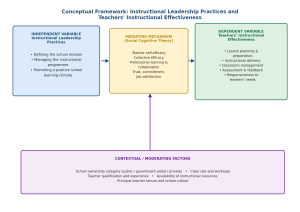
The conceptual framework (Figure 1) positions instructional leadership practices (the three Hallinger–Murphy dimensions) as the independent variable and teachers’ instructional effectiveness as the dependent variable. Teacher self-efficacy and related professional beliefs (collective efficacy, professional learning, trust, commitment, and job satisfaction) are positioned as a plausible mediating mechanism grounded in Social Cognitive Theory (Bandura, 1997; Hallinger et al., 2025a; Karakose et al., 2024; Zhang et al., 2025). Contextual and moderating factors (class size and workload, teacher qualification and experience, the length of the principal–teacher relationship, school ownership type, and resource availability) may strengthen or weaken the hypothesised relationship. The present study estimates the direct association between the three leadership dimensions and effectiveness; the mediating and moderating elements frame interpretation and future work.
Figure 1. Conceptual framework showing the influence of instructional leadership practices on teachers’ instructional effectiveness.
1.6 Objectives, Research Questions, and Hypothesis
The general objective was to examine the influence of instructional leadership practices on teachers’ instructional effectiveness in selected upper-secondary schools. The specific objectives, with their corresponding research questions (RQ), were:
- To assess the extent to which principals implement instructional leadership practices (RQ1: To what extent are instructional leadership practices implemented?).
- To determine the level of teachers’ instructional effectiveness (RQ2: What level of instructional effectiveness do teachers display?).
- To examine the influence of instructional leadership practices on teachers’ instructional effectiveness and identify the strongest predictors (RQ3: Which leadership practices most strongly predict effectiveness?).
The study tested the following hypotheses: H₀: There is no statistically significant influence of instructional leadership practices on teachers’ instructional effectiveness in selected secondary schools. H₁: There is a statistically significant influence of instructional leadership practices on teachers’ instructional effectiveness in selected secondary schools. The study was delimited to upper-secondary (A-Level) schools in Gakenke District during the 2025/2026 academic period.
2. Methods
2.1 Research Design
The study used a convergent parallel mixed-methods design with a descriptive–correlational quantitative strand (Creswell & Plano Clark, 2018). Quantitative and qualitative data were collected during the same period, analysed separately, and merged at the interpretation stage. The descriptive component measured levels of leadership implementation and teacher effectiveness; the correlational component assessed the strength and direction of their relationship; and standard multiple regression evaluated the predictive power of each leadership dimension. Qualitative interviews with principals and senior teachers, together with independent classroom observation, provided contextual depth and a means of triangulating the self-reported data.
2.2 Study Setting
The study was conducted in Gakenke District, Northern Province, Rwanda, which has 365,292 inhabitants across 703.9 km² and 19 sectors (National Institute of Statistics of Rwanda [NISR], 2023). The district is predominantly rural, and its public, government-aided, and private secondary schools face resource and logistical constraints typical of rural Rwandan contexts.
2.3 Population and Sampling
The target population comprised all 171 A-Level teachers across the district’s 30 upper-secondary schools and all 30 school principals or head teachers (Gakenke District Education Office, 2025). Given the manageable population, a census of all 30 principals was conducted for both the survey and the qualitative interviews. For teachers, stratified random sampling ensured proportionate representation across the three ownership categories (public/government, government-aided, and private), with simple random (lottery) selection within each stratum. Yamane’s (1967) formula, n = N / [1 + N(e)²], with N = 171 and e = .05, yielded a minimum sample of 120 teachers. To guard against non-response, all 171 teachers were targeted; 162 valid questionnaires were returned, a response rate of 94.7% (Table 1). In addition to the 30 principals, 15 senior teachers took part in interviews, and 20 A-Level lessons were observed across the sampled schools.
Table 1. Distribution of Schools, Teachers, and Principals by School Ownership
| School ownership | Schools | Target teachers | Returned (n) | Principals (n) |
| Public/Government | 8 | 48 | 46 | 8 |
| Government-aided | 16 | 92 | 87 | 16 |
| Private | 6 | 31 | 29 | 6 |
| Total | 30 | 171 | 162 | 30 |
Note. Response rate for teachers = 162/171 = 94.7%. Source: Gakenke District Education Office (2025) and field data.
2.4 Instruments
Four instruments were used. (1) A teacher questionnaire adapted from Hallinger’s PIMRS and from established instructional-effectiveness scales measured the three leadership dimensions and the five effectiveness domains on 5-point Likert scales. (2) A parallel principal self-assessment questionnaire captured principals’ own views of their practice. (3) A classroom observation checklist, used by the researcher to independently triangulate 20 A-Level lessons, rated the same five effectiveness domains. (4) Semi-structured interview guides were administered to principals and senior teachers to explore supervision practices, feedback, constraints, and enabling conditions. The quantitative analyses reported below are based on teacher responses (n = 162); principals’ responses and interview data informed interpretation.
Validity and reliability
Content and construct validity were established through expert review by university supervisors and senior educational-management faculty at EAUR, with items refined to align with CBC curriculum demands. A pilot study involving 20 teachers and 3 principals in neighbouring Rulindo District, outside the target sample, informed reliability testing. Cronbach’s alpha exceeded the conventional .70 threshold for all scales (Table 2).
Table 2. Internal Consistency of the Study Scales (Pilot Study)
| Scale | Cronbach’s α | Interpretation |
| Defining the School Mission | .842 | Good |
| Managing the Instructional Programme | .876 | Good |
| Promoting a Positive School Learning Climate | .859 | Good |
| Overall Instructional Effectiveness | .891 | Good |
Note. Interpretation follows the convention that α ≥ .80 indicates good reliability. The pilot included 20 teachers and 3 principals.
2.5 Data Collection Procedure
Research permits were obtained from the Gakenke District Administration and the Sector Education Officers before fieldwork. Questionnaires were distributed to the sampled teachers in their schools, interviews were conducted with principals and senior teachers, and classroom observations were carried out by the researcher using the standardised checklist. Participants were assured of confidentiality and of their right to withdraw at any stage.
2.6 Data Analysis
Quantitative data were analysed in SPSS version 28. Descriptive statistics (means, standard deviations, and frequencies) addressed objectives 1 and 2, and mean scores were interpreted on a five-band scale: 1.00–1.80 (very low), 1.81–2.60 (low), 2.61–3.40 (moderate), 3.41–4.20 (high), and 4.21–5.00 (very high). Pearson correlation and standard multiple linear regression (B, β, R², F, t) tested H₀ and addressed objective 3, with all three leadership dimensions entered simultaneously as predictors of the composite effectiveness score. Multicollinearity was assessed using tolerance and variance inflation factors (VIF). To aid interpretation, 95% confidence intervals for unstandardized coefficients, adjusted R², Cohen’s (1988) f², and squared partial correlations (computed as t²/(t² + df)) were derived from the reported regression output.
Interview transcripts were analysed thematically following Braun and Clarke’s (2006) framework: familiarisation, initial coding, theme generation, review, definition, and reporting. Quantitative and qualitative results were then integrated through a joint display (Table 8) that juxtaposes convergent and divergent findings.
2.7 Ethical Considerations
Ethical approval was obtained from the EAUR Research Ethics Committee, and research permits were granted by Sector Education Officers and the Gakenke District Administration. Informed consent was obtained from all participants, participation was entirely voluntary, and coded identifiers (e.g., Teacher T_1, Principal P_3) protected anonymity. Because the design is cross-sectional, it cannot establish causal inference; independent classroom observation and interview triangulation were used to mitigate the social-desirability bias associated with self-report questionnaires.
3. Results
3.1 Respondent Profile
Of 171 teacher questionnaires distributed, 162 valid responses were returned (94.7%), and all 30 targeted principals participated in the survey and interviews. The teaching workforce was predominantly male (66.7%) and professionally qualified, with 85.2% holding a Bachelor’s degree (A0), consistent with MINEDUC standards for secondary teachers. More than 86% had three or more years of teaching experience, indicating strong familiarity with secondary pedagogy and school leadership dynamics. By ownership, 53.7% of respondents worked in government-aided schools, 28.4% in public schools, and 17.9% in private schools.
3.2 Extent of Instructional Leadership Implementation (RQ1)
Overall, teachers rated principals’ implementation of instructional leadership as high (M = 3.91, SD = 0.52). As shown in Table 3, promoting a positive school learning climate ranked highest (M = 4.08), followed by defining the school mission (M = 3.96), while managing the instructional programme ranked lowest (M = 3.68), although it too fell in the “high” band.
Table 3. Teachers’ Ratings of Principals’ Instructional Leadership by Dimension (N = 162)
| Dimension | M | SD | Rank | Rating |
| Promoting a Positive School Learning Climate | 4.08 | 0.48 | 1 | High |
| Defining the School Mission | 3.96 | 0.53 | 2 | High |
| Managing the Instructional Programme | 3.68 | 0.55 | 3 | High |
| Composite Instructional Leadership | 3.91 | 0.52 | — | High |
Note. Rating bands: 3.41–4.20 = high. Composite is the mean of the three dimension means.
Item-level results added nuance. Within the mission dimension, principals scored highest on communicating academic goals clearly (M = 4.12) but lower on involving teachers in setting instructional priorities (M = 3.82), pointing to a largely top-down approach to goal-setting. Within instructional-programme management, direct classroom observation and feedback recorded the lowest item mean of the entire survey (M = 3.42), only marginally above the threshold of the “high” band, which suggests that broad administrative monitoring is more common than direct pedagogical coaching. Within climate promotion, protecting instructional time from interruptions (M = 4.18) and fostering staff collaboration (M = 4.12) scored highest.
3.3 Level of Teachers’ Instructional Effectiveness (RQ2)
Teachers reported a high overall level of instructional effectiveness (M = 4.06, SD = 0.44). Table 4 shows that lesson planning and preparation was rated very high (M = 4.28), while responsiveness to diverse learner needs (M = 3.92) and assessment practice and timely feedback (M = 3.86) were comparatively lower.
Table 4. Teachers’ Self-Reported Instructional Effectiveness by Domain (N = 162)
| Domain | M | SD | Rating |
| Lesson Planning and Preparation | 4.28 | 0.42 | Very high |
| Classroom Management and Time Use | 4.18 | 0.44 | High |
| Instructional Delivery and Active Pedagogy | 4.06 | 0.48 | High |
| Responsiveness to Diverse Learner Needs | 3.92 | 0.49 | High |
| Assessment Practice and Timely Feedback | 3.86 | 0.51 | High |
| Composite Instructional Effectiveness | 4.06 | 0.44 | High |
Note. Rating bands: 3.41–4.20 = high; 4.21–5.00 = very high.
Independent observation of 20 lessons largely corroborated the self-reports for lesson planning and classroom management but revealed widening gaps in the domains that depend on interaction with individual learners (Table 5, Figure 2). Observed means were close to self-reports for lesson planning (4.20 vs. 4.28) and classroom management (4.10 vs. 4.18), indicating strong alignment. A moderate divergence emerged for instructional delivery (3.82 vs. 4.06), reflecting continued reliance on lecture methods in large classes, and larger divergences appeared for assessment and feedback (3.54 vs. 3.86) and responsiveness to learner needs (3.48 vs. 3.92). These patterns indicate that individualised formative feedback and differentiation are harder to observe in practice than teachers perceive, particularly given class-size constraints.
Table 5. Self-Reported and Observed Instructional Effectiveness
| Domain | Self-report M | Observed M | Difference | Gap (% of self-report) |
| Lesson planning and preparation | 4.28 | 4.20 | 0.08 | 1.9 |
| Classroom management and time use | 4.18 | 4.10 | 0.08 | 1.9 |
| Instructional delivery | 4.06 | 3.82 | 0.24 | 5.9 |
| Assessment and feedback | 3.86 | 3.54 | 0.32 | 8.3 |
| Responsiveness to learner needs | 3.92 | 3.48 | 0.44 | 11.2 |
Note. Self-report: N = 162 teachers; observed: 20 lessons. Differences and percentages were computed from the reported means and are descriptive only; no significance test was applied given the small number of observed lessons.
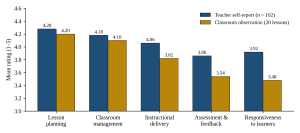
Figure 2. Teachers’ self-reported and independently observed instructional effectiveness by domain.
3.4 Relationship between Leadership and Effectiveness (RQ3)
Pearson correlation confirmed a strong, statistically significant positive relationship between overall instructional leadership and teacher effectiveness, r = .684, p < .001 (95% CI [.59, .76]; shared variance r² = .47). Among the sub-dimensions, managing the instructional programme showed the strongest bivariate association with effectiveness (r = .648), followed by promoting climate (r = .582) and defining mission (r = .512); all were significant at p < .001 and large by conventional benchmarks (Table 6).
Table 6. Pearson Correlations between Leadership Dimensions and Instructional Effectiveness (N = 162)
| Leadership measure | r | r² | p | Strength |
| Managing the Instructional Programme | .648 | .420 | < .001 | Large |
| Promoting a Positive School Learning Climate | .582 | .339 | < .001 | Large |
| Defining the School Mission | .512 | .262 | < .001 | Large |
| Composite Instructional Leadership | .684 | .468 | < .001 | Large |
Note. Strength follows Cohen’s (1988) benchmarks (r ≥ .50 = large). r² values were computed from the reported coefficients.
3.5 Multiple Regression: Predictors of Instructional Effectiveness
A standard multiple linear regression, entering the three leadership dimensions simultaneously, yielded R = .722 and R² = .521 (adjusted R² = .512), indicating that 52.1% of the variance in teachers’ instructional effectiveness is explained by principals’ instructional leadership practices; this corresponds to a large effect (Cohen’s f² = 1.09). The model was statistically significant, F(3, 158) = 57.341, p < .001, leading to the rejection of H₀ and acceptance of H₁. Collinearity diagnostics (all VIF < 2.0) showed no multicollinearity problem. Table 7 presents the coefficients.
Table 7. Regression Coefficients Predicting Teachers’ Instructional Effectiveness (N = 162)
| Predictor | B | SE | 95% CI for B | β | t | p | pr² | VIF |
| (Constant) | 1.124 | 0.214 | — | — | 5.252 | < .001 | — | — |
| Defining the Mission | 0.152 | 0.058 | [0.04, 0.27] | .184 | 2.615 | .010 | .041 | 1.610 |
| Managing Instruction | 0.338 | 0.058 | [0.22, 0.45] | .421 | 5.814 | < .001 | .176 | 1.634 |
| Promoting Climate | 0.286 | 0.066 | [0.16, 0.42] | .312 | 4.302 | < .001 | .105 | 1.873 |
Note. R² = .521; adjusted R² = .512; F(3, 158) = 57.341, p < .001. 95% confidence intervals and squared partial correlations (pr²) were derived from the reported B, SE, and t values.
The standardised coefficients reveal the relative predictive strength of each dimension. Managing the instructional programme was the strongest unique predictor (β = .421, p < .001): a one-standard-deviation increase in instructional-management behaviours was associated with a 0.42 standard-deviation increase in teacher effectiveness, holding the other dimensions constant. In raw units, a one-point increase on the five-point management scale corresponded to a 0.34-point increase in effectiveness. Promoting a positive school learning climate was the second strongest predictor (β = .312, p < .001). Defining the school mission, though statistically significant, was the weakest unique predictor (β = .184, p = .010). The unstandardized regression equation is: Instructional Effectiveness = 1.124 + 0.152(Mission) + 0.338(Management) + 0.286(Climate). Figure 3 contrasts how strongly each dimension is implemented with how strongly it predicts effectiveness: the dimension with the lowest implementation score carries the greatest predictive weight.
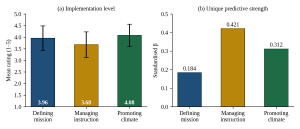
Figure 3. Implementation level (a) and unique predictive strength (b) of the three instructional leadership dimensions. Error bars in panel (a) show one standard deviation.
3.6 Qualitative Findings
Thematic analysis of interviews with 30 principals and 15 senior teachers produced three convergent themes.
Theme 1: The transformative power of post-observation feedback
Teachers described direct classroom observation combined with reflective, non-punitive feedback as far more influential on their practice than general staff meetings. One senior physics teacher explained that having the head teacher observe a lesson and then discuss the phrasing of formative questions immediately changed the teacher’s subsequent lesson planning in ways that generic training could not replicate. Participants valued feedback that was specific, tied to what had been seen in the classroom, and delivered in a professional rather than evaluative tone.
Theme 2: Administrative workload as a supervisory barrier
Principals acknowledged that financial audits, district meetings, administrative reporting, and student discipline frequently displace instructional monitoring. Several principals noted that, while they understood clinical classroom supervision to be a core responsibility, external administrative compliance demands left little time during the school day for formal observations. Class sizes were also noted as constraining the individualised feedback that supervision is meant to support.
Theme 3: Resources and school climate as enabling factors
Teachers and principals concurred that protecting instructional time from disruption and ensuring adequate teaching and learning resources foster a supportive environment that strengthens teacher confidence and classroom performance. This theme corroborates the quantitative finding that climate promotion is comparatively well implemented.
3.7 Integration of Quantitative and Qualitative Findings
Table 8 integrates the two strands. In every area where both strands spoke to the same issue, they converged.
Table 8. Joint Display of Quantitative and Qualitative Findings
| Issue | Quantitative result | Qualitative result | Integrated interpretation |
| Direct supervision | Managing the programme lowest dimension (M = 3.68); observation and feedback lowest item (M = 3.42) | Audits, meetings, reporting, and discipline displace classroom observation | Convergence: supervision is under-implemented because of workload |
| Value of feedback | Managing the programme strongest predictor (β = .421) | Reflective, non-punitive feedback more influential than staff meetings | Convergence: coaching-type supervision drives practice change |
| Climate and resources | Climate highest-rated (M = 4.08); second predictor (β = .312) | Protected time and resources strengthen teacher confidence | Convergence: climate is a well-established enabling condition |
| Mission setting | Weakest predictor (β = .184); teacher involvement item M = 3.82 | No distinct theme identified | Mission-setting is necessary but less decisive; participation could be widened |
| Assessment and differentiation | Lowest self-reported domains; largest self-report–observation gaps | Class size and workload constrain individual feedback | Practice gaps are partly structural, not only a matter of skill |
Note. The mission-setting row reflects the three themes reported in Section 3.6.
4. Discussion
4.1 Implementation of Instructional Leadership
Principals in Gakenke District were rated as implementing instructional leadership to a high degree overall, but the profile across dimensions is uneven. Climate promotion and mission definition scored highest, while managing the instructional programme scored lowest, and within it the single item on direct classroom observation and feedback was the weakest in the instrument. This pattern suggests that principals are more comfortable with broad goal-setting and organisational oversight than with the time-intensive, pedagogically demanding work of classroom supervision. It is consistent with Sibomana’s (2022) finding that Rwandan secondary-school principals enacted instructional leadership only moderately and faced barriers of workload and limited training. The interviews in the present study explain the pattern in similar terms: audits, district meetings, reporting, and discipline crowd out supervision even where principals regard it as a core responsibility.
Two cautions apply. First, all three dimensions fell within the “high” band, and the lowest item mean (3.42) sits barely above its lower boundary, so the labels should not be read as evidence that supervision is robust. Self-reported ratings in Likert-type surveys tend to cluster toward the favourable end, and a rating of 3.4 on an item about classroom observation may mask the infrequent, irregular supervision described in the interviews. Second, the relatively lower rating on involving teachers in setting instructional priorities (3.82, compared with 4.12 for communicating goals) points to a top-down style of goal-setting. Hallinger et al. (2025b) show that the leadership–efficacy relationship varies with cultural context, and a hierarchical school culture may help explain why goals are communicated more readily than co-constructed. This interpretation is tentative, since the present data do not measure school culture.
4.2 Teachers’ Instructional Effectiveness and the Perception–Practice Gap
Teachers rated their own effectiveness highly, especially in lesson planning (M = 4.28). The strength in planning is plausible given MINEDUC and REB accountability requirements for schemes of work and lesson plans, which make planning the most visible and most routinely checked part of teaching. It also shows that structural compliance is within the system’s reach.
The weaker domains are those that require continual, learner-by-learner adjustment: assessment and feedback, and responsiveness to diverse needs. The observation data show that these are precisely the domains in which self-reports overstate what can be seen in classrooms (gaps of 8.3% and 11.2% of the self-reported mean, compared with 1.9% for planning and classroom management). Teachers’ confidence in these practices exceeds their observable enactment, which is consistent with continued reliance on lecture methods in large classes. This is educationally significant because the CBC presumes active learning and frequent formative assessment, and because formative feedback is among the most strongly supported means of raising learning (Black & Wiliam, 1998). The result also supports Taylor and Thion’s (2023) argument that teaching effectiveness should be assessed using multiple sources of evidence; a study relying on self-report alone would have overstated effectiveness in precisely the areas where support is most needed. Because only 20 lessons were observed and no inferential test was applied, these comparisons should be regarded as indicative rather than definitive.
4.3 Which Leadership Dimensions Matter Most?
Leadership practices jointly explained 52.1% of the variance in teachers’ instructional effectiveness, a large effect by conventional benchmarks. Such a figure is much larger than the modest, largely indirect effects usually reported for principals’ influence on student achievement (Hallinger & Heck, 1996), but this is expected: the outcome here is teachers’ practice, which lies much closer to the principal’s sphere of action than test scores. The magnitude should nevertheless be treated cautiously because both leadership and effectiveness were self-reported by the same teachers, a situation in which shared method variance can inflate associations (Podsakoff et al., 2003).
Managing the instructional programme was the strongest unique predictor (β = .421), consistent with the global evidence that this dimension accounts for the largest share of explained variance in teacher efficacy (Hallinger et al., 2025b) and with Robinson et al.’s (2008) finding that hands-on involvement in curriculum, teaching, and teacher learning carries the greatest weight. Studies of instructional coaching likewise report meaningful improvements in teaching practice when teachers receive observation-based feedback (Kraft et al., 2018). The interviews offer a concrete picture of how this might work: a head teacher’s discussion of the phrasing of formative questions changed a physics teacher’s planning in ways generic training did not. Promoting climate was the second strongest predictor (β = .312), underscoring that protected instructional time, collaboration, and adequate resources are real preconditions for good teaching. Defining the mission was the weakest unique predictor (β = .184) but remained significant; clear goals appear necessary as a foundation, yet they matter less to day-to-day teaching quality than the supervisory work that translates goals into classroom practice.
The most striking pattern is the mismatch shown in Figure 3: the dimension that principals implement least is the one that most strongly predicts effectiveness. In practical terms, the marginal return to strengthening supervision appears greater than the return to further strengthening already well-implemented dimensions. Because the design is cross-sectional, this should be read as a strong association and a promising priority for intervention, not as proof that increased supervision will cause an equivalent improvement in teaching.
4.4 Interpreting the Findings through Social Cognitive Theory
Social Cognitive Theory offers a coherent way of reading these results, although the study did not measure self-efficacy and therefore cannot confirm the mechanism. Observation followed by specific, supportive feedback is a source of social persuasion anchored in a teacher’s actual performance, and when it leads to improved lessons it generates mastery experiences, the strongest source of efficacy beliefs (Bandura, 1997; Tschannen-Moran & Woolfolk Hoy, 2001). This would explain why direct instructional management predicted effectiveness more strongly than general goal-setting or climate-building. The mediating role of collective efficacy found in meta-analytic work (Karakose et al., 2024) and the links between instructional leadership and teacher self-efficacy in specific domains of practice (Zhang et al., 2025) are consistent with this account, as is the broader finding that leadership works through collaboration and professional learning (Ninković & Knežević Florić, 2024). Testing these pathways directly is a priority for future research.
4.5 Implications
For theory, the findings support treating instructional leadership as a multidimensional construct whose components carry unequal weight, rather than as a single composite, and they extend evidence on this point to a rural, upper-secondary context in Sub-Saharan Africa. For policy, they suggest that accountability systems that reward administrative compliance may unintentionally divert principals from the supervisory work that matters most; the Imihigo performance contracts and district reporting requirements are obvious levers. For practice, they point to training principals in clinical supervision and in giving non-punitive feedback, protecting time for observation, and supporting teachers in formative assessment and differentiation within large classes. The convergence between survey and interview evidence (Table 8) strengthens confidence that these implications reflect conditions in schools and not only patterns in the survey data.
4.6 Limitations
Several limitations should be acknowledged. First, the cross-sectional design precludes causal inference; reverse causation is possible, as more effective teachers may be easier to supervise or may attract more supportive leadership. Second, leadership and effectiveness were both reported by teachers, which raises the risk of common-method bias and social-desirability effects; the observation of 20 lessons by a single researcher mitigates but does not eliminate this risk, and the observed sample is too small for inferential comparison. Third, teachers are nested within 30 schools, and a single-level regression does not model school-level clustering. Fourth, the study covers one rural district and A-Level schools only, which limits generalisability to urban or lower-secondary settings. Fifth, the mediating and moderating variables in the conceptual framework (self-efficacy, class size, teacher qualification, resources) were not measured, so the mechanisms proposed are interpretive. Finally, the integration of the principals’ own survey responses with the teacher data is limited, and the regression is based on teacher ratings alone.
4.7 Directions for Future Research
Future studies should pursue longitudinal or quasi-experimental designs that track the effect of structured clinical supervision on teaching practice and national assessment outcomes; extend the inquiry to other provinces and to urban districts such as Kigali City to examine urban–rural leadership dynamics; use multilevel modelling to account for the nesting of teachers within schools; combine teacher, principal, and independent observational ratings in larger observed samples; and apply structural equation modelling to test the mediating roles of teacher self-efficacy, professional learning communities, collective efficacy, and trust in leadership.
5. Conclusion
Principals in Gakenke District’s upper-secondary schools consistently practise instructional leadership, particularly in defining institutional goals and fostering a positive learning climate, but their direct involvement in classroom supervision and pedagogical coaching remains limited. A-Level teachers display high structural compliance in lesson planning and classroom organisation but need targeted support in formative assessment and differentiated instruction. Principal instructional leadership explains just over half of the variance in teachers’ instructional effectiveness (R² = .521), and active management of the instructional programme (classroom observation, curriculum alignment, and post-observation feedback) is a more powerful correlate of teaching quality (β = .421) than general goal-setting or climate promotion alone. By isolating the relative predictive power of distinct instructional leadership dimensions in a rural Rwandan upper-secondary setting, the study contributes context-specific evidence to educational leadership scholarship and shows that the least-implemented dimension is the most consequential.
Declarations
Funding: The authors received no specific funding for this work.
Declaration of competing interest: The authors declare that they have no known competing financial interests or personal relationships that could have influenced the work reported in this paper.
Data availability: The anonymized questionnaire dataset is available from the corresponding author on reasonable request.
Acknowledgments: The authors thank staff of secondary schools and all staff of Gakenke District for their participation and cooperation.
References
Bandura, A. (1997). Self-efficacy: The exercise of control. W. H. Freeman.
Black, P., & Wiliam, D. (1998). Assessment and classroom learning. Assessment in Education: Principles, Policy & Practice, 5(1), 7–74. https://doi.org/10.1080/0969595980050102
Braun, V., & Clarke, V. (2006). Using thematic analysis in psychology. Qualitative Research in Psychology, 3(2), 77–101. https://doi.org/10.1191/1478088706qp063oa
Cohen, J. (1988). Statistical power analysis for the behavioural sciences (2nd ed.). Lawrence Erlbaum Associates.
Creswell, J. W., & Plano Clark, V. L. (2018). Designing and conducting mixed methods research (3rd ed.). SAGE.
Gakenke District Education Office. (2025). Annual education statistics and secondary school census report. Gakenke District Administration.
Hallinger, P. (2011). Leadership for learning: Lessons from 40 years of empirical research. Journal of Educational Administration, 49(2), 125–142. https://doi.org/10.1108/09578231111116699
Hallinger, P., & Heck, R. H. (1996). Reassessing the principal’s role in school effectiveness: A review of empirical research, 1980–1995. Educational Administration Quarterly, 32(1), 5–44. https://doi.org/10.1177/0013161X96032001002
Hallinger, P., & Murphy, J. (1985). Assessing the instructional management behaviour of principals. The Elementary School Journal, 86(2), 217–247. https://doi.org/10.1086/461445
Hallinger, P., Liu, S., & Chen, L. (2025a). Principal instructional leadership and teacher attitudes: A meta-analytic review, 1989–2024. European Journal of Education, 60(4), Article e70199. https://doi.org/10.1111/ejed.70199
Hallinger, P., Liu, S., & Niu, X. (2025b). Cultural context, principal instructional leadership, and teacher efficacy: A meta-analytic review, 1989–2024. Educational Management Administration & Leadership. Advance online publication. https://doi.org/10.1177/17411432251349810
Hallinger, P., Liu, S., Aung, P. N., & Yan, M. (2025c). A systematic review of instructional leadership research conducted with the Principal Instructional Management Rating Scale (PIMRS), 1983–2024. Educational Management Administration & Leadership. Advance online publication. https://doi.org/10.1177/17411432251358575
He, P., Guo, F., & Abazie, G. A. (2024). School principals’ instructional leadership as a predictor of teachers’ professional development. Asian-Pacific Journal of Second and Foreign Language Education, 9(1), Article 63. https://doi.org/10.1186/s40862-024-00290-0
Karakose, T., Kardas, A., Kanadlı, S., Tülübaş, T., & Yildirim, B. (2024). How collective efficacy mediates the association between principal instructional leadership and teacher self-efficacy: Findings from a meta-analytic structural equation modeling (MASEM) study. Behavioural Sciences, 14(2), Article 85. https://doi.org/10.3390/bs14020085
Kraft, M. A., Blazar, D., & Hogan, D. (2018). The effect of teacher coaching on instruction and achievement: A meta-analysis of the causal evidence. Review of Educational Research, 88(4), 547–588. https://doi.org/10.3102/0034654318759268
Leithwood, K., Harris, A., & Hopkins, D. (2020). Seven strong claims about successful school leadership revisited. School Leadership & Management, 40(1), 5–22. https://doi.org/10.1080/13632434.2019.1596077
Ministry of Education. (2024). Education sector strategic plan 2024–2029 (ESSP). Republic of Rwanda.
National Institute of Statistics of Rwanda. (2023). Fourth population and housing census, Rwanda, 2022: Gakenke District profile. Government of Rwanda.
Ninković, S., & Knežević Florić, O. (2024). School leadership and teaching practice: A systematic review of studies of the indirect effects. Journal of Educational Administration, 62(4), 357–372. https://doi.org/10.1108/JEA-10-2023-0225
Nirere, J., Ntawiha, P., & Buhigiro, J. L. (2023). Influence of primary school head teachers’ instructional leadership on teachers’ professional practices in Musanze District, Rwanda. East African Journal of Education and Social Sciences, 4(4), 143–150. https://doi.org/10.46606/eajess2023v04i04.0312
Ntahomvukiye, C. (2012). The impact of principals’ leadership behaviours on teachers’ job satisfaction in Rwanda: A case study of secondary schools in the Gakenke District [Doctoral thesis, University of the Witwatersrand].
Podsakoff, P. M., MacKenzie, S. B., Lee, J.-Y., & Podsakoff, N. P. (2003). Common method biases in behavioural research: A critical review of the literature and recommended remedies. Journal of Applied Psychology, 88(5), 879–903. https://doi.org/10.1037/0021-9010.88.5.879
Robinson, V. M. J., Lloyd, C. A., & Rowe, K. J. (2008). The impact of leadership on student outcomes: An analysis of the differential effects of leadership types. Educational Administration Quarterly, 44(5), 635–674. https://doi.org/10.1177/0013161X08321509
Sibomana, I. (2022). Perceptions of teachers on the instructional leadership behaviours of secondary school principals in Rwanda. Educational Management Administration & Leadership, 50(1), 64–80. https://doi.org/10.1177/1741143220938365
Taylor, S., & Thion, S. (2023). How has teaching effectiveness been conceptualized? Questioning the consistency between definition and measure. Frontiers in Education, 8, Article 1253622. https://doi.org/10.3389/feduc.2023.1253622
Tschannen-Moran, M., & Woolfolk Hoy, A. (2001). Teacher efficacy: Capturing an elusive construct. Teaching and Teacher Education, 17(7), 783–805. https://doi.org/10.1016/S0742-051X(01)00036-1
Tubisabimana, E., & Mukulira, O. (2022). Influence of instructional leadership practices on teacher continuous professional development in selected public primary schools in Rwanda. Journal of Education. Advance online publication. https://doi.org/10.53819/81018102t3057
Yamane, T. (1967). Statistics: An introductory analysis (2nd ed.). Harper & Row.
Zhang, N., Siaw, Y.-L., & Jiang, N. (2025). The relationship between principal instructional leadership and teacher self-efficacy in student engagement and classroom management: A cross-sectional study in China. Frontiers in Psychology, 16, Article 1589958. https://doi.org/10.3389/fpsyg.2025.1589958