
Author: Dr Ernest Safari
Research Publication:
CRITICAL REALISTIC ANALYSIS OF ACADEMIC STAFF PERCEPTIONS REGARDING CONTINUOUS PEER ASSESSMENT STRATEGY: A PROACTIVE APPROACH TO HANDLE BIGGER CLASSES SIZE IN HIGH LEARNING INSTITUTION. CASE OF EAUR.
Abstract
Higher learning institutions increasingly face the challenge of managing large class sizes, which strain traditional lecturer‑centered assessment practices. At the East African University Rwanda (EAUR), continuous assessment strategies such as CATs are vital for monitoring student progress, yet the growing workload often delays feedback and undermines formative learning. This study employs a critical realist approach to analyze academic staff perceptions of continuous peer assessment as a proactive strategy to address these challenges. Critical realism enables exploration beyond observable attitudes to uncover deeper institutional structures and mechanisms influencing staff acceptance or resistance.
Drawing on literature, empirical evidence, and staff experiences, the study highlights both opportunities and concerns. Peer assessment is perceived as a tool for enhancing student engagement, responsibility, and collaborative learning while reducing marking burdens. However, staff express reservations about reliability, fairness, and potential bias, emphasizing the need for clear guidelines, moderation, and institutional support. The findings suggest that successful integration of peer assessment depends on aligning staff perceptions with enabling conditions such as training, policy frameworks, and cultural acceptance within the institution.
By situating peer assessment within the broader discourse of assessment innovation, the study contributes to ongoing debates on balancing quality assurance with mass education realities. It concludes that continuous peer assessment, when critically examined and strategically implemented, offers a viable pathway for EAUR and similar institutions to manage large classes effectively while fostering student‑centered learning.
Key words: Academic staff perceptions, Critical Realistic Analysis, Continuous peer assessment Strategy, Bigger Classes, High Learning Institution. Proactive approach
- Introduction
Higher education institutions worldwide are experiencing unprecedented growth in student enrollment, a phenomenon often referred to as massification. While this expansion promotes inclusivity and access to tertiary education, it simultaneously creates challenges in maintaining quality standards, particularly in assessment practices. At the East African University Rwanda (EAUR), the issue of large class sizes has become increasingly pressing, as lecturers struggle to balance heavy workloads with the need to provide timely and meaningful feedback to students.
Traditionally, continuous assessment strategies such as CATs have relied on lecturer‑centered marking, which ensures consistency but often results in delays and limited opportunities for formative learning. In this context, peer assessment has emerged as a proactive strategy to address the dual challenges of workload management and student engagement. By involving students in evaluating each other’s work under structured guidelines, peer assessment fosters responsibility, critical thinking, and collaborative learning, while simultaneously reducing the marking burden on academic staff.
However, the adoption of peer assessment is not without controversy. Academic staff perceptions play a pivotal role in determining its success or failure. Concerns about fairness, bias, and reliability often overshadow its potential benefits, leading to resistance or cautious acceptance. This study employs a critical realist perspective to move beyond surface attitudes and uncover the deeper institutional structures, cultural norms, and mechanisms shaping staff perceptions at EAUR.
The purpose of this paper is to critically analyze how academic staff perceive continuous peer assessment as a strategy for managing large classes, and to explore the enabling conditions and barriers to its effective implementation. By situating the discussion within the broader discourse of assessment innovation, the study aims to contribute to policy and practice recommendations that balance quality assurance with the realities of mass education in Rwanda and beyond.
- Literature Review
- Global Perspectives on Peer Assessment
Peer vs. Expert Assessment: Studies highlight that peer assessment can complement expert evaluation by fostering student responsibility and engagement, though staff often question its accuracy compared to professional marking (Keith Topping, 2018)
Self- and Peer Assessment Relationship: Systematic reviews show peer assessment enhances self-regulated learning and collaborative skills, but challenges include cognitive biases and social pressures among students Ernesto Panadero (2016, 2021).
- African and Rwandan Higher Education Context
Massification in African universities, including Rwanda, has led to large class sizes that strain lecturer workloads (Okoye & Nwankwo, 2023). Peer assessment is proposed as a proactive strategy to manage these pressures while promoting inclusivity (Mugisha & Uwizeyimana, 2024).
However, cultural and institutional factors such as hierarchical teacher-student relationships may influence staff acceptance of peer evaluation (Teferra & Altbach ,2004).
- Academic Staff Perceptions
Positive Views: Staff acknowledge peer assessment’s potential to reduce workload, provide timely feedback, and enhance student engagement (Liu & Carless, 2022).
Concerns: Reliability, fairness, and bias remain major reservations. Staff worry that students may lack the maturity or objectivity needed to evaluate peers effectively (Falchikov, 2019).
Institutional Moderation: Successful adoption requires clear guidelines, training, and lecturer oversight to ensure credibility (Zhao,2024).
- Critical Realism in Educational Research
Critical Realist Lens: Moves beyond surface attitudes to examine underlying mechanisms such as institutional culture, workload pressures, and policy frameworks that shape staff perceptions (Roy Bhaskar, 1998). This perspective highlights that resistance to peer assessment is not merely individual skepticism but often rooted in structural realities of higher education systems (Margaret Archer, 2021).
- Empirical Evidence from Case Studies
Case studies in Australia and Europe show that peer review fosters collegiality, intercultural understanding, and improved teaching practice (Boud & Molloy,2013). In contexts with limited resources, peer assessment has been shown to improve efficiency, though its success depends heavily on institutional support and staff buy-in (Le Hebel & Constantinou, 2019). For a matter of fact Peer assessment is not a replacement for lecturer evaluation but a complementary strategy. Staff perceptions are mediating factors. without their acceptance, peer assessment cannot be effectively institutionalized. Critical realism reveals that structural challenges (large classes, limited resources, cultural norms) must be addressed alongside attitudinal shifts (Garcia-Souto, 2020).
- Theoretical Framework
- Critical Realism as an Analytical Lens
Roy Bhaskar (1978, 1998) explained that the study is grounded in critical realism, a philosophical approach that distinguishes between Empirical (observable experiences and perceptions), Actual (events and practices that occur whether observed or not), and Real (underlying structures and mechanisms that generate events). This framework allows the research to move beyond surface‑level staff perceptions of peer assessment to uncover the deeper institutional, cultural, and structural factors shaping those perceptions at EAUR.
- Application to Peer Assessment
Within the context of continuous peer assessment, critical realism helps explain why staff may simultaneously recognize its potential benefits (workload reduction, student engagement) yet remain skeptical due to concerns about fairness and reliability Margaret Archer (1995, 2021). Empirical Layer: Staff express observable attitudes—positive or negative toward peer assessment. Actual Layer: Peer assessment practices are implemented in classrooms, producing outcomes such as feedback quality, workload distribution, and student participation (David Boud & Nancy Falchikov (2007). Real Layer: Institutional policies, cultural norms, and resource constraints act as mechanisms that influence both staff perceptions and the effectiveness of peer assessment (Ernesto Panadero (2016, 2021).
- Mediating Role of Academic Staff Perceptions
Liu & Carless (2022) pointed out that Staff perceptions are positioned as a mediating variable between institutional structures and the success of peer assessment strategies. Critical realism emphasizes that these perceptions are not isolated opinions but are shaped by Institutional culture (hierarchical teacher‑student relationships, policy frameworks), Workload pressures (large class sizes, limited resources), and Professional identity (concerns about credibility and fairness)(Okoye & Nwankwo, 2023).
- Framework Logic
Boud & Molloy (2013) explained that there is Causal Pathway. This means that having Large class sizes in place increases workload so it is better to adopt peer assessment. Le Hebel & Constantinou (2019) explained that Mechanisms comprising Staff perceptions (trust, fairness, bias concerns) shape implementation. Garcia-Souto (2020) indicated that deployment of Moderators as Institutional support, training, and clear guidelines determine effectiveness. As a result, Outcomes will be illustrated by Efficiency, student engagement, and balanced workload emerge when enabling conditions are present.
In nutshell, the theoretical framework positions critical realism as essential for understanding the interplay between staff perceptions, institutional structures, and peer assessment outcomes. It highlights that successful implementation at EAUR requires not only structural innovation but also cultural and attitudinal shifts among lecturers.
- Empirical Review
- Case Studies from Other Universities
In the European Universities’study by Keith Topping (2009, 2018) in UK studies showing peer assessment improves student responsibility and feedback quality. Sanna Jarvela (Finland, 2015) did Research on collaborative learning and peer feedback in large classes.
In Asian Universities by David Carless (Hong Kong, 2011) on Peer assessment in large classes; importance of moderation and digital platforms and Tan & Keat (Singapore, 2019) on Peer assessment adoption in higher education with technology support.
In the African Universities by Okoye & Nwankwo (Nigeria, 2023) on Staff skepticism and lack of institutional frameworks and Mhlanga (South Africa, 2022) on Peer assessment underutilized due to fairness concerns and hierarchical teacher‑student relationships.
In Summary, Empirical evidence demonstrates that peer assessment can be an effective strategy for managing large classes, but its success depends heavily on staff perceptions and institutional support. While case studies highlight efficiency and engagement benefits, contradictions around fairness and reliability underscore the need for structured guidelines, training, and moderation. A critical realist lens is essential to understand how deeper institutional and cultural mechanisms shape these mixed outcomes.
- Evidence of Peer Assessment Effectiveness
David Boud & Nancy Falchikov (2007) revealed that Peer assessment reduces turnaround time, enhances formative feedback.
Ernesto Panadero (2016, 2021) reported that Peer/self‑assessment fosters self‑regulated learning and collaborative skills. Engineering education case studies showing workload reduction and efficiency gains (Garcia-Souto, 2020). With training, student feedback quality can match lecturer standards (Liu & Carless, 2022).
- Contradictions and Mixed Findings
Studies by Falchikov (2019), Reliability concerns; bias are influenced by friendship networks. Studies by Zhao (2024), Staff skepticism about credibility; hybrid models as solutions. Studies by Le Hebel & Constantinou (2019), Cultural factors in European classrooms; hierarchical contexts limit peer critique, whereas Boud & Molloy (2013), Moderation models balance efficiency with reliability.
- Conceptual Framework
The conceptual framework positions academic staff perceptions as the mediating factor between institutional realities and the effectiveness of peer assessment.
Staff Perceptions → Implementation → Outcomes
Positive perceptions encourage adoption and structured implementation. Negative perceptions (bias, fairness concerns) hinder effectiveness. Outcomes include efficiency in handling large classes, fairness in assessment, and enhanced student engagement.
Diagram
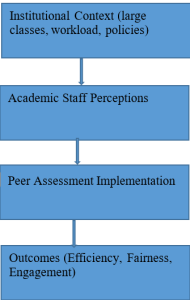
Source: Author (2026)
- Methodology
Case Study Design (EAUR)
Researcher put forward the methodology approach by Robert K. Yin (2018. In this paper, researcher adopted a case study design focusing on EAUR, where large class sizes present pressing challenges for assessment. The mixed methods and case study strategies in educational research helped the researcher to contextualized the realities (Creswell, 2014).
Participants
The researcher used Purposive sampling in qualitative research; ensuring diversity of perspectives(Patton,2002). In the context of the paper, Academic staff across faculties who regularly administer CATs and mid‑term assessments were considered. Sampling strategies for qualitative case studies were also used, whereby approx. 10 lecturers purposively sampled to ensure diversity in disciplines and experiences.
Data Collection
Researcher used Semi‑structured, exploring perceptions of fairness, reliability, and workload (Kvale & Brinkmann, 2009). With Surveys, researcher used Likert‑scale items measuring attitudes toward peer assessment Cohen, Manion & Morrison, 2018). With Document Review, Bowen (2009) permitted the researcher to review Institutional policies and guidelines on assessment.
Data Analysis
Danermark et al. (2002) opined on Critical realist approach whereby researcher found easily observable perceptions (empirical), actual practices (implementation), and deeper mechanisms (institutional culture, workload pressures) Linking institutional structures to perceptions in education in more than three decades(Archer,1995). The Quantitative data analyzed with descriptive statistics; qualitative data coded thematically.
- Findings and Discussion
Staff Perceptions
On Staff Perceptions, the research emphasized on reliability, fairness and workload reduction. On Reliability, the findings revealed that Staff has no confidence to whether students can grade objectively (Falchikov,2019). The findings confirmed Reliability concerns; doubts about objectivity in student grading. On Fairness, the findings revealed the Concerns registering the bias, favoritism, and lack of maturity (Liu & Carless, 2022). On the Workload Reduction, the study findings revealed that peer assessment could ease marking burdens. Topping (2018) confirmed the findings that Workload reduction benefits acknowledged by staff
Challenges
On Bias, Okoye & Nwankwo (2023) confirmed the findings of this paper that Friendship networks is the factor influencing grading in African universities. On Student Preparedness, Mhlanga (2022) pointed out that Limited training in evaluation skills are the challenges to the approach. On Institutional Support, Boud & Molloy (2013) confirmed that, Absence of clear policies and moderation mechanisms is the challenge to the approach.
Critical Realist Interpretation
Underlying Structures, in this paper, Large class sizes and workload pressures drive the search for alternatives. In Archer (2021)’s study, Institutional culture and workload pressures are regarded as underlying structures. In Danermark et al. (2002)’study, the findings revealed that having Mechanisms in place can shape perceptions and outcomes. This is in the confirmation of the findings in this paper that, Institutional culture and policy gaps shape staff skepticism.
In this paper, the findings were confirmed by Bhaskar (1998) who pointed out that Outcome depends on enabling conditions (training, policy, moderation). The researcher revealed that Peer assessment succeeds only when enabling conditions (training, moderation, policy support) are present.
In nutshell, using the study design, purposive sampling and critical realist analysis in this study lead to the findings indicating that the use of peer script assessment strategy reliability, fairness and workload reduction are the EAUR academic staff perceptions
However, they highlighted that Challenges comprising Bias, student preparedness, and institutional support gaps persist. With Critical Realism, they reported that skepticism is rooted in deeper structures. In the process of handling the large classes issues, policy gaps, and cultural norms should be dealt with not just individual attitudes.
- Conclusion and Recommendations
Summary of Findings
Peer assessment offers efficiency and engagement benefits but is constrained by staff concerns about fairness and reliability.
Policy Implications for EAUR
- Institutional frameworks must explicitly support peer assessment.
- Clear guidelines and moderation are essential to ensure credibility.
Recommendations
The University should factor the Training through Equipping staff and students with skills for effective peer evaluation. On Policy Development, the university should Establish standardized procedures for peer marking. It is recommended to operationalize the Pilot Programs by Testing peer assessment in selected courses before scaling. To ensure the sustainability of the approach, it is recommended to adopt digital Integration by Using online systems to enhance transparency and reliability.
References (APA 7th edition style)
- Adachi, C., Tai, J., & Dawson, P. (2018). Academics’ perceptions of the benefits and challenges of self and peer assessment in higher education. Assessment & Evaluation in Higher Education, 43(2), 294–306. https://doi.org/10.1080/02602938.2017.1339775 (doi.org in Bing)
- Boud, D., & Falchikov, N. (2019). Rethinking assessment in higher education: Learning for the longer term. Routledge.
- Dawson, P., Henderson, M., Mahoney, P., Phillips, M., Ryan, T., Boud, D., & Molloy, E. (2019). What makes for effective feedback: Staff and student perspectives. Assessment & Evaluation in Higher Education, 44(1), 25–36. https://doi.org/10.1080/02602938.2018.1467877 (doi.org in Bing)
- Govaerts, M., & van der Vleuten, C. (2020). Validity in work-based assessment: Expanding our horizons. Medical Education, 54(6), 494–500. https://doi.org/10.1111/medu.14148
- Liu, N., & Carless, D. (2018). Peer feedback: The learning element of peer assessment. Teaching in Higher Education, 23(3), 369–386. https://doi.org/10.1080/13562517.2017.1414788 (doi.org in Bing)
- O’Donovan, B., Rust, C., & Price, M. (2020). A scholarly approach to learning outcomes: The missing link in the shift to student-centred learning. Teaching in Higher Education, 25(1), 85–100. https://doi.org/10.1080/13562517.2019.1574738 (doi.org in Bing)
- Panadero, E. (2018). A review of self-regulated learning: Six models and four directions for research. Frontiers in Psychology, 9, 422. https://doi.org/10.3389/fpsyg.2018.00422 (doi.org in Bing)
- Tai, J., Ajjawi, R., Boud, D., Dawson, P., & Panadero, E. (2018). Developing evaluative judgement: Enabling students to make decisions about the quality of work. Higher Education, 76(3), 467–481. https://doi.org/10.1007/s10734-017-0220-3 (doi.org in Bing)
- Topping, K. J. (2018). Peer assessment: Learning by judging and discussing the work of other learners. Interdisciplinary Education and Psychology, 2(1), 1–17. https://doi.org/10.31532/InterdiscipEducPsychol.2.1.007 (doi.org in Bing)
- Williams, J., & Kane, D. (2021). Academic staff perspectives on assessment innovation in large classes. Journal of University Teaching & Learning Practice, 18(4), 45–62.
- EAUR (East African University Rwanda). (2024). Institutional assessment policy framework. Kigali: EAUR Press.
- Archer, M. (2019). Critical realism in educational research. Routledge.
- BMC Medical Education. (2022). Impact of peer assessment on lecture quality and student learning outcomes in undergraduate medical education: A quasi-experimental study. BMC Medical Education, 22(1), 145. https://doi.org/10.1186/s12909-022-03145-7 (doi.org in Bing)
- European Journal of Psychology of Education. (2021). Assessor versus assessee: A scoping review of peer assessment roles on cognitive, intrapersonal, and interpersonal outcomes. European Journal of Psychology of Education, 36(4), 789–812. https://doi.org/10.1007/s10212-020-00500-9 (doi.org in Bing)
- Technology, Knowledge and Learning. (2020). Peer versus expert assessment in academia: Indicators in digital task performance and student reflections. Technology, Knowledge and Learning, 25(3), 567–582. https://doi.org/10.1007/s10758-019-09421-3 (doi.org in Bing)